
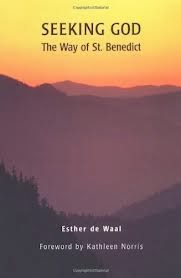
BOOK REVIEW :: Seeking God: The Way of St. Benedict by Esther de Waal

Seeking God: The Way of Saint Benedict

by

Esther de Waal

One of my new favorite people is Esther de Waal. In my opinion Esther is responsible for the global growth of the Oblate movement for the last 30 years. Her book Seeking God: The Way of Saint Benedict brings St Benedict’s Rule to life for those trying to live monastic principles in our ordinary lives outside monastery walls.

Ms. de Wall breaks down the Rule, written by a celibate man to other celibate men over 1500 years ago, into ways that can be applied to every life. Along with the beautifully translated Rule, each chapter is punctuated with sweet prayers and quotations perfect for a devotional or meditation time.

I learned many things in this wonderful book. But the most important is something I use every day; a principle that is tied to our daily work, whatever it may be.

Reflecting on this quote from the Rule:

He will regard all utensils and goods of the monastery as sacred vessels of the altar, aware that nothing is to be neglected. (RB 31.2)

Esther de Waal writes:

What we can learn from the Rule is that the sense of God’s presence can be mediated throughout daily work and not destroyed by it…  seeking God does not demand the unusual, the spectacular, the heroic. It asks of me as wife, mother, housewife that I do the most ordinary, often dreary and humdrum things that face me each day, with a loving openness that will allow them to become my own immediate way to God. (Ch VII Material Things)

After reading this I put a daily ritual in place to help me keep this forefront in my mind. I start each morning by lighting a candle at my kitchen altar where I have placed a reminder card of this principle. Prayerfully, I dedicate my hands and work to God. Reminding myself that every implement of my work is a sacred vessel on the altar of my transformation. This immediately puts my heart attitude in check with the Holy Spirit.

You may not be interested in becoming an Oblate. But if you are pursuing spiritual growth, I highly recommend you read Seeking God: The Way of St. Benedict. Esther’s words have been so inspirational to me. This is a book I will read again and again!

If you can’t see the screen below CLICK HERE for a beautiful teaching by Esther de Waal given at St. Paul’s Cathedral in London in 2013. I love love love this woman! Her spirit is so sweet! I hope you enjoy her as much as I do. Blessings… Tamara

A Monk in the World :: LECTIO DIVINA

In Monk in the World we are learning the values, teachings and principles of Christian monasticism and how we can apply them to our lives outside the monastery walls. Today we’re focusing on the Prayer of Lectio Divina.

Lectio divina which means “holy or divine reading”  is an ancient form of prayer using Scripture as the voice of God to our heart. This type of prayer is simple in concept but  powerful in practice, taking us deeper and deeper in our relationship with God.


There are various takes on the practice of lectio divina. We are going to use the one I’ve learned from my resources listed below. Before beginning any prayer time we must find a quiet place to sit with the Lord. Focusing on our breath, we prepare to listen as the Holy Spirit brings openness and guidance.

  1. LECTIO: (Latin for reading) In this step we read a section of Scripture slowly, savoring each word as a delicious morsel that will nourish our soul. It’s helpful to read the passage aloud watching ever closely for a word or phrase that shimmers in our heart.
  2. MEDITATIO: (Latin for mediation) Here we take the phrase that caught our heart’s attention and ruminate on it through repetition and reflection. As we chew on the given text we connect it with our life situations.
  3. ORATIO: (Latin for prayer) In this next step we actually begin our conversion with God, our closest friend and confidant who we can share anything with. Here we may find much needed joy and gratitude; a renewal of hope and trust.
  4. CONTEMPLATIO (Latin for contemplation) Here we stop doing and just be, we still our hearts and minds, find rest in God’s loving arms as His precious child. We may continue our reading or end our prayer with thanksgiving.
Certainly one of my favorite passages of Scripture to meditate on is Psalm 23. Here are a few others you may consider:

Psalm 51 “Have mercy on me, O God, according to your steadfast love.”
Psalm 91 “You who live in the shelter of the Most High”
Romans 8 “There is therefore no condemnation…

I hope you will enjoy the practice of lectio divina. I’m looking forward to putting it more into practice for myself this upcoming year.

Blessings…

RESOURCES:
St. Benedicts Toolbox: The Nuts and Bolts of Everyday Benedictine Living by Jane Tomaine
Monk Habits for Everyday People: Benedictine Spirituality for Protestants by Dennis Okholm
How to be a Monastic and Not Leave your Day Job by Br. Benet Tvedten