
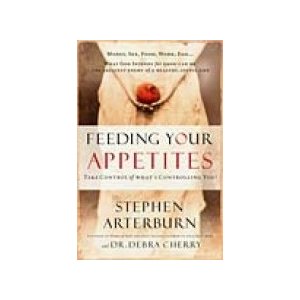
BOOK REVIEW ~ Feeding Your Appetites: Take Control of What’s Controlling You!


Feeding Your Appetites: 
Take Control of What’s Controlling You! 
by @SteveArterburn
Thomas Nelson Publishers 2006
206 pp


If you’re not familiar with Stephen Arterburn — check him out. He has been an incredibly important influence on me from the early days of my recovery. In fact The Life Recovery Bible, which he edited and produced with David Stoop, saved my life!


Stephen Arterburn is the founder and chairman of New Life Ministries and is the host of the nationally syndicated “New Life Live!” daily radio program. Steve’s also the founder of the Women of Faith conferences and has written over 60 books. This isn’t a Stephen Arterburn advertisement, but I want to put into perspective the value you will get from reading his book.


In Feeding Your Appetites Mr. Arterburn shows us in the beginning, at creation, all our appetites were intended for good. It was only after the fall of man that our natural appetites took on unhealthy purposes.


The career we choose…

  • the way we spend our money
  • how often we want sex and what kind we want
  • the types of friends we build relationships with
  • the amount of champagne we drink at a party  
  • how we prioritize our activities

…all reflect our distinctive appetites and desires. 

Our appetites motivate us to seek fulfillment, but they must be managed or they will lead us into a world of regret and tremendous emotional pain. When an appetite intended to help us survive is managed incorrectly, it may become a trap holding us in a deadly grip. Until we give ourselves and our appetites completely over to God, we will remain trapped. ~ Stephen Arterburn


While reading Feeding Your Appetites we will recognize the influences that have led to our poor choices, we will pave new pathways and learn how to fill these natural voids in healthy ways. We will begin to cultivate godly appetites and ultimately live a surrendered life. To ensure our success Stephen has a simple Twelve Step process to help us evaluate our circumstances and map the areas where we’re struggling. Also included is a study guide for use with family or small groups.


If you struggle with appetites that have grown out of control consider reading Feeding Your Appetites by Stephen Arterburn.

An enjoyable read that can bring a better life. I highly recommend it!


Working the Steps: Step 4


Step 4: We made a searching and fearless moral inventory of ourselves.

The first time I worked this step was in therapy almost eight years ago. It was shocking to see all my addictions, compulsions and perversions written down on paper. Because much of my life had been lived in a daze of fantasy and denial; it was like reading about someone else.

In Steps One, Two and Three, with the help of the Virtues: Honesty, Hope and Faith, we have submitted to God’s authority over our lives and have converted our doubt and fear into peace with God. In Step 4 we beginning the growth steps, by examining our past behavior we will work towards understanding and eventually finding peace with ourselves.

It’s critical when taking our inventory that we look at our strengths as well as our weaknesses. Often when reflecting on ourselves we focus on the bad things and beat ourselves down with guilt and condemnation. But when we include our strengths in the evaluation we can see the potential for greatness God has put in us which accelerates us forward on our recovery journey.

In the traditional AA Step Four, we take only a moral inventory: weaknesses, wrongs, character defects, faults and shortcomings. In the Christ-centered Celebrate Recovery, Step Four includes also a Spiritual Inventory. Let me clarify with text from the Celebrate Recovery Bible:

Inventory:

  • THE PERSON: List persons or things we resent. (Fear and anger are clues.)
  • THE CAUSE: List specific actions someone took that hurt us. (Why we resent them?)
  • THE EFFECT: List how the specific hurtful action effected us.
  • THE DAMAGE: List how that specific hurtful action still effects us.
  • MY PART: Honestly determine any resentments, sins, or injury we’re responsible for.

Spiritual Inventory:

  • OUR RELATIONSHIP WITH OTHERS: Who hurt us? Are we still holding a grudge? Seeking revenge? Jealous? Bad attitude? Who have I hurt?
  • OUR PRIORITIES IN LIFE: Is there an area of life we’re keeping from God? What have been our life priorities? What was wrong with those priorities? Who did those priorities affect and how?
  • OUR BODY: How have we mistreated our body? Are there activities / habits that caused physical harm?
  • OUR FAMILY: Have we mistreated anyone in our family? Do we owe them amends? What family secret are we denying?
  • OUR CHURCH: Have we been faithful to our church in the past? Have w been critical instead of active and supportive? Have we discouraged our family’s support of their church?

Step Four begins the process of coming clean. With pen and paper in hand, prayerfully ask God to reveal His truth about you to you. Remember, God does not give us a spirit of fear, but of power, love and a sound mind. (2Tim. 1:7) With strength given by the Holy Spirit we can push through the denial, past resentments and the fear of acknowledging who and what we have been, to become free and whole in Jesus Christ.

Let us examine our ways and test them, and let us return to the Lord. — Lamentations 3:40

I hope you enjoy the theme song for our Working the Steps series:
Step by Step by @Bryan_Duncan http://youtu.be/swNgb9ya6WM

Resources: Life Recovery Bible, Celebrate Recovery Bible, The Twelve Steps for Christians.